




Tuesday, 25 August 2026 11:30 AM
Product Announcements
Built for intersections, corridors, and municipal traffic networks that must resolve vehicles and license plates around the clock, this camera pairs the Sony IMX678 STARVIS 2 sensor with HDR, NIR sensitivity, and Dual-Band Wi-Fi, giving traffic technology providers detailed 4K video without a cable run to every pole or camera position across a city.
FORT WORTH, TX / ACCESS Newswire / August 25, 2026 / Vadzo Imaging, a world leader in embedded vision solutions, today announced the positioning of the Wave-678CRE, a 4K HDR Wi-Fi Camera built around the Sony IMX678 STARVIS 2 sensor for smart traffic management, license plate recognition, and intersection monitoring deployments that need dependable wireless video day and night.
Why Smart Traffic Management Needs a 4K HDR Wi-Fi Camera Built for Around the Clock Visibility
Traffic infrastructure presents a lighting and connectivity problem that few other camera applications combine in the same installation. An intersection camera has to resolve a license plate or a vehicle's position clearly in bright midday sun, in the deep shadow of an overpass, and again at night under nothing but streetlights and headlights, all from a fixed mounting position that cannot be repositioned or relit to compensate. A camera without genuine HDR and low light handling produces footage that is only reliable during a fraction of a typical day, which is not acceptable for infrastructure that is expected to document every vehicle that passes, not just the ones that happen to pass during good lighting conditions.
An IMX678 Low-Light Wi-Fi Camera approaches the night time half of that problem directly, extending usable sensitivity well past the point where a standard sensor would need supplemental lighting. A NIR WiFi Camera Module configuration then extends that capability further, using near infrared sensitivity to maintain plate legible detail even under illumination levels a human eye would consider effectively dark.
A second, more practical challenge is getting that video off the pole and into a traffic management system without running new cabling to every camera position in a city. A Wireless Traffic Camera approaches that installation problem directly, using wireless connectivity to reach camera positions mounted on poles, signal masts, and overpasses where running fiber or copper back to a network closet would be prohibitively expensive across a citywide deployment.
These two challenges, unreliable lighting and difficult cable runs, tend to appear at the exact same locations rather than independently. An overpass or a rural intersection is often both the hardest place to light consistently and the hardest place to reach with a wired network connection, which means a camera that solves only one of these problems still leaves a municipality with gaps in its network at precisely the sites that need coverage the most.
Engineering Explanation: Visibility, Dynamic Range, and Connectivity Together
Sony developed the IMX678 as part of its second generation STARVIS lineup, extending Back-Side Illuminated pixel architecture with further improvements to low light and near infrared sensitivity over the original STARVIS generation. As a Sony IMX678 WiFi Camera, the sensor pairs that STARVIS 2 foundation with 8 megapixel, 4K capable resolution, giving traffic technology providers a single sensor that resolves both wide intersection views and individual license plates from the same hardware.
Near infrared sensitivity is what makes usable night time plate recognition possible without relying entirely on visible light sources a municipality cannot always control. As a Sony STARVIS 2 WiFi Camera, the Wave-678CRE extends its response into the near infrared band, which matters directly for intersections where streetlight coverage is inconsistent or where a municipality wants covert night operation without adding visible illumination. An HDR NIR Wireless Camera configuration like this one combines that infrared sensitivity with on-chip HDR, holding detail in both a headlight glare and the shadowed area beside it within the same frame.
Dual-Band Wi-Fi is the connectivity feature that makes wireless deployment practical at traffic infrastructure scale. As a Dual-Band NIR Camera, the Wave-678CRE can operate on either the 2.4 GHz or 5 GHz band depending on which offers a cleaner connection at a given intersection, which matters because traffic infrastructure sites often already have other wireless equipment, from municipal Wi-Fi to nearby cellular infrastructure, competing for the same spectrum. A Wireless NIR Sensor Camera configuration gives traffic technology providers a fallback option rather than a single fixed frequency that may not perform consistently across every intersection in a network.
Together, these capabilities let a 4K WiFi HDR Camera Module cover the full range of conditions a traffic camera actually encounters: a 4K NIR Wireless Camera configuration for night time plate recognition, an 8MP Wireless NIR Camera configuration for detailed daytime intersection monitoring, and a 4K Low Light Wireless Camera configuration for the transition periods at dawn and dusk when lighting changes fastest.
Product Overview
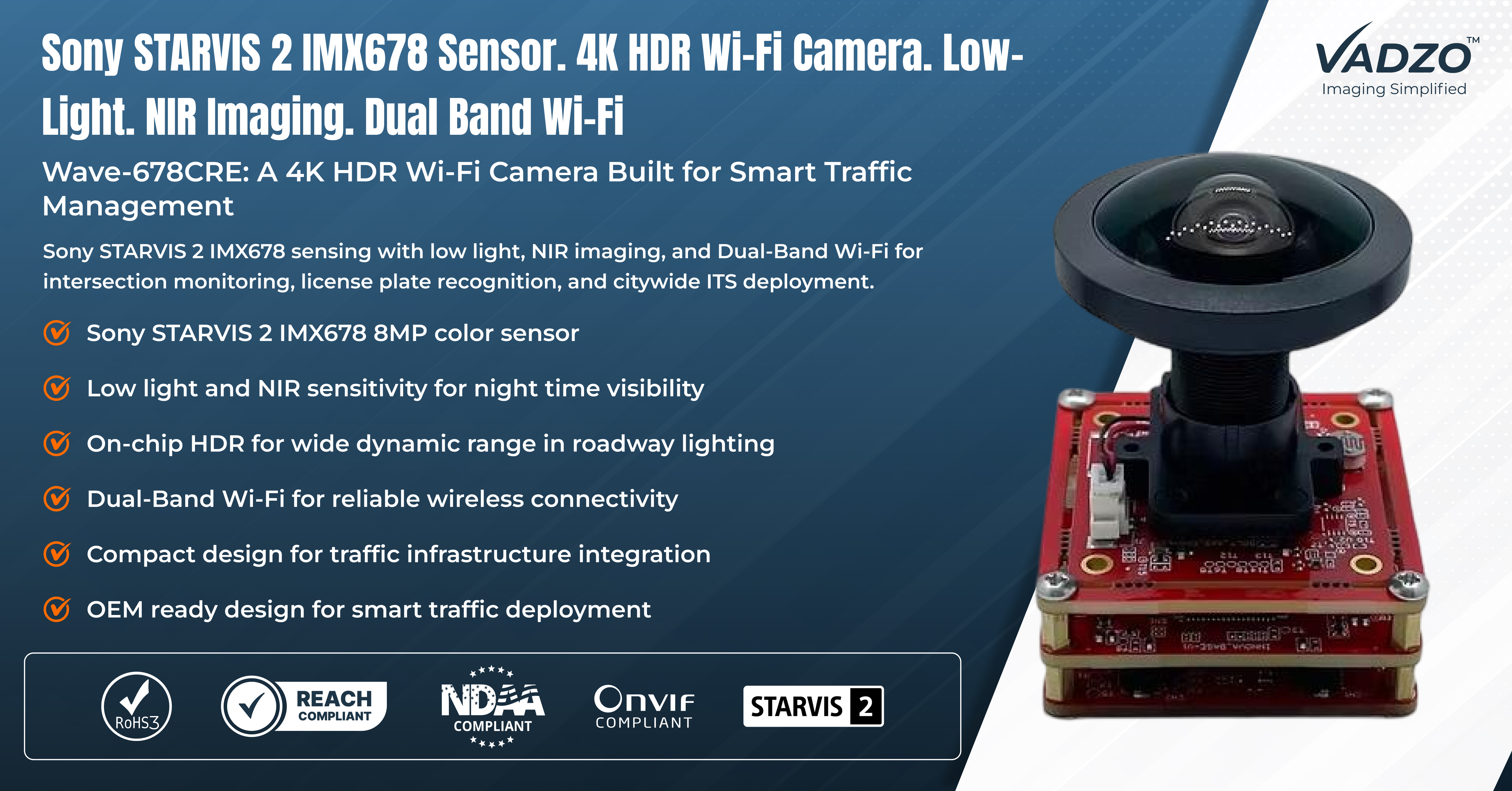
The Wave-678CRE pairs the IMX678 4K Wi-Fi Camera sensor with HDR, NIR sensitivity, ONVIF Compliance, and Dual-Band Wi-Fi in a compact design suited to pole, mast, and overpass mounted traffic infrastructure. As a 4K HDR Wi-Fi Camera, it outputs full 8 megapixel, 4K capable resolution with HDR and NIR sensitivity active by default, giving traffic technology providers a single camera platform that covers license plate recognition, intersection monitoring, and general roadway observation from one module.
At the core of the module sits the IMX678 HDR Wi-Fi Camera sensor, chosen specifically for the combination of resolution, dynamic range, and low light sensitivity that traffic infrastructure requires around the clock. Because the camera pairs IMX678 Wireless Camera connectivity with 8MP HDR WiFi Camera imaging, the Wave-678CRE reaches usable image quality whether an intersection is lit by midday sun, an overpass shadow, or nothing more than streetlights and headlights after dark.
Product Specifications
Sensor: Sony STARVIS 2 IMX678 CMOS Sensor
Sensor Size: 1/1.8 inch
Pixel: 2.0 µm × 2.0 µm
Resolution: 8MP (3856 × 2180)
Shutter: Rolling shutter
Interface: Dual-Band Wi-Fi (2.4 GHz / 5 GHz)
Key Capabilities
Sony IMX678 STARVIS 2 Sensor for Detailed 4K / 8MP Capture: The Wave-678CRE is built around the Sony IMX678 sensor, a second generation STARVIS device that resolves fine detail across a full intersection or roadway scene rather than cropping or subsampling to reach a marketing resolution number. This gives the module genuine 8 megapixel, 4K capable performance suited to traffic applications that need to read a license plate at distance while still monitoring a wide intersection view in the same frame.
Low Light and NIR Imaging for Night Time Traffic Visibility: Streetlight coverage varies significantly from one intersection to the next, and a traffic camera that depends entirely on visible light infrastructure it does not control will perform inconsistently across a network. Near infrared sensitivity extends the Wave-678CRE's usable range well into conditions a human eye would consider effectively dark, maintaining plate legible detail without requiring a municipality to add or upgrade street lighting at every camera position. As a Low Light NIR WiFi Camera, it delivers that capability specifically over a wireless connection, avoiding the cable run a wired NIR camera would otherwise require.
HDR for Wide Dynamic Range in Variable Roadway Lighting: A single intersection frame routinely contains bright headlight glare, a shadowed overpass, and everything in between, which is a dynamic range problem a fixed exposure setting cannot solve regardless of how carefully it is tuned. On-chip HDR processing holds detail across that full range in a ingle exposure, avoiding the ghosting a moving vehicle would introduce into a multi frame blended HDR image, which matters directly for traffic scenes that are essentially never still.
ONVIF Compliance for Seamless Traffic System Integration: The Wave-678CRE supports ONVIF-compliant integration, enabling compatibility with a wide range of network video recorders (NVRs), video management systems (VMS), and IP-based surveillance and traffic management platforms. This allows traffic technology providers to integrate the camera into existing infrastructure without being locked into a proprietary video management ecosystem. For smart traffic deployments spanning multiple intersections, ONVIF compatibility can simplify camera discovery, video streaming, system configuration, and interoperability across different network video devices and software platforms.
Dual-Band Wi-Fi for Reliable Wireless Connectivity: Traffic infrastructure sites often share their immediate radio environment with municipal Wi-Fi networks, nearby cellular equipment, and other wireless traffic sensors, all competing for the same limited spectrum. Dual-Band Wi-Fi lets the Wave-678CRE fall back to the comparatively open 5 GHz band when 2.4 GHz congestion would otherwise affect video quality, giving traffic technology providers a second option without redeploying the camera or adding a wired connection at a difficult intersection.
Compact Design for Traffic Infrastructure Integration: Traffic camera housings mounted on a signal mast, a pole, or an overpass structure typically have limited space and need to withstand outdoor conditions without frequent maintenance access. The Wave-678CRE's compact design fits within that constrained space, and as a WiFi Vision Camera Module, it integrates directly into existing traffic infrastructure mounting hardware without requiring a custom enclosure redesign. That compatibility with existing mounting hardware matters directly for municipalities upgrading an established traffic camera network, since replacing an enclosure at every intersection would add significant cost and installation time to what should otherwise be a straightforward camera upgrade.
OEM Ready Design for Smart Traffic Deployment: Traffic technology providers deploying camera units across a citywide network need a platform that stays consistent across hundreds or thousands of intersections rather than varying between installation phases. Vadzo Imaging supports full customization on this platform as an OEM Wireless Traffic Camera, including connector changes, housing design, and firmware adjustments for traffic technology providers headed into municipal scale deployment.
"Traffic agencies do not get to reschedule a violation or an intersection incident for better lighting. The IMX678's STARVIS 2 low light and NIR sensitivity combined with HDR gives the Wave-678CRE a genuinely reliable record of what happened at an intersection, day or night, glare or shadow, delivered over Dual-Band Wi-Fi that reaches poles and masts a wired connection never could economically. We built this camera for networks measured in hundreds of intersections, not a single well lit test site." - Alwin Vincent, Product Manager at Vadzo Imaging
Application-Specific Sections
Intersection Monitoring and Traffic Flow: Intersection monitoring systems need a camera that resolves both individual vehicles and overall traffic flow patterns across lighting conditions that shift constantly throughout a day. As a Smart Traffic Management Camera, the Wave-678CRE's HDR and NIR sensitivity hold detail across that full range, and functioning as a Traffic Management Camera, it extends the same reliability to general flow monitoring and congestion analysis at the same location. As an Intersection Monitoring Camera, it also supports dedicated single intersection deployments where broader network integration is not yet in place.
License Plate Recognition: License plate recognition depends on resolving small text clearly under headlight glare, streetlight illumination, or near total darkness, often from a vehicle moving at speed through the frame. As a License Plate Camera, the Wave-678CRE's NIR sensitivity and HDR processing keep plate characters legible across that range, and a License Plate Recognition Camera configuration of the same module integrates directly with existing municipal enforcement and tolling systems.
Speed Enforcement and Red Light Monitoring: Speed enforcement and red light monitoring systems need footage detailed and reliable enough to support enforcement decisions, which places a higher standard on image quality than general observation alone. As a Speed Enforcement Camera, the Wave-678CRE delivers that level of detail, and functioning as a Red Light Camera Module, it extends the same reliability to signal violation documentation at the same intersection.
Wireless ITS Deployment: Intelligent transportation system networks spanning many intersections across a city need connectivity that does not require a fiber or copper run to every single camera position. As a Wireless ITS Camera, the Wave-678CRE supports that kind of citywide deployment, and a Dual-Band Traffic Camera configuration of the same module gives network planners flexibility in which wireless band each intersection actually uses based on local radio conditions. That flexibility becomes increasingly valuable as a network grows, since a planner can adjust band selection at individual problem intersections without redesigning the connectivity approach for the entire deployment.
OEM Integration for Traffic Technology Providers: Traffic technology providers building their own ITS platforms need a camera vendor who understands the connectivity, durability, and image quality requirements a municipal deployment demands. The Wave-678CRE ships from a Wireless Traffic Camera Manufacturer with those requirements built in, and Vadzo Imaging supports OEM customization for cable length, connector type, and firmware for providers standardizing on one camera across multiple ITS product lines. As a WiFi NIR Camera Kit, it fits directly into a provider's existing deployment workflow without requiring a redesign around a new camera's specific requirements.
Frequently Asked Questions
Q: Why does a traffic camera need near infrared sensitivity rather than relying on streetlights or headlights for night visibility?
A: Streetlight coverage and headlight positioning are both outside a camera's control and vary significantly from one intersection to another, which means a camera that depends entirely on that visible light will perform inconsistently across a network rather than delivering the same reliability everywhere. Near infrared sensitivity extends a sensor's usable range well into conditions a human eye would consider effectively dark, maintaining legible detail on a plate or vehicle regardless of how well a specific intersection happens to be lit. The Wave-678CRE combines this NIR capability with 8MP resolution and HDR in an 8MP HDR Wi-Fi Camera designed for reliable traffic imaging in low-light conditions. Vadzo Imaging builds NIR sensitivity into its traffic camera products specifically because a municipality cannot always control or upgrade street lighting at every location. A single unlit or poorly lit intersection in an otherwise well covered network can become a recurring blind spot in enforcement or incident records, which is a real operational cost that outweighs whatever was saved by choosing a camera without genuine NIR capability.
Q: Why does a wireless traffic camera specifically need Dual-Band Wi-Fi rather than a single 2.4 GHz connection?
A: Traffic infrastructure sites often share their immediate radio environment with municipal Wi-Fi networks, nearby cellular equipment, and other wireless sensors, all competing for the same 2.4 GHz spectrum that many consumer and industrial wireless devices default to. A Dual-Band camera can fall back to the comparatively open 5 GHz band when 2.4 GHz congestion would otherwise degrade video quality, which matters at scale since a citywide deployment will inevitably include some intersections with heavier wireless interference than others. The Wave-678CRE combines Dual-Band Wi-Fi with 4K HDR imaging, making it a 4K HDR Wi-Fi Camera suited to traffic deployments where both wireless connectivity and image quality are critical. Vadzo Imaging includes Dual-Band Wi-Fi on its traffic camera products so a network planner has a real option at every intersection rather than accepting degraded connectivity at the specific locations where radio conditions happen to be worst.
Q: Can a single wireless camera really handle both license plate recognition and general intersection monitoring at the same location?
A: Yes, provided the camera combines enough resolution to resolve plate detail at typical roadway distances with wide dynamic range and low light sensitivity that hold up across a full day and night cycle. The Wave-678CRE combines these capabilities in a single 4K HDR Wi-Fi Camera, delivering 8MP resolution with HDR and NIR sensitivity for both license plate recognition and general intersection monitoring. A camera specified narrowly for one task, such as plate recognition alone, often still has the resolution and image quality headroom to also serve general intersection monitoring at the same location, since the harder technical requirement of plate legibility tends to exceed what basic flow monitoring alone would demand. Vadzo Imaging designs its traffic camera products around that dual purpose use case specifically, since most municipal deployments would rather standardize on one capable camera per intersection than install separate hardware for enforcement and general monitoring.
Q: Can Vadzo Imaging customize a wireless traffic camera module for a specific ITS or municipal platform?
A: Yes. Vadzo Imaging supports full OEM customization across its traffic camera portfolio, including housing design suited to a specific pole, mast, or overpass mounting position, connector and cable configuration, and firmware adjustments tuned for a particular HDR or NIR sensitivity profile. Evaluation units ship with no minimum order requirement, and the same engineering team that built the standard product works directly with ITS technology providers and municipal integrators to adapt the module for a specific traffic management platform headed into citywide deployment.
Q: What should municipal and ITS technology providers look for when choosing the Wave-678CRE for a citywide traffic camera rollout?
A: A camera that performs well at a single well-lit test intersection does not automatically perform the same way once deployed across hundreds of locations with varying lighting, radio conditions, and mounting positions, since the specific combination of challenges at any one intersection is rarely identical to the test site. Providers should look for genuine low-light and NIR performance rather than specifications that only hold up in daylight, a wireless connectivity approach with a real fallback option for congested radio environments, and a supplier able to support consistent hardware and firmware across a multi-year municipal rollout. The Wave-678CRE is an 8MP HDR Wi-Fi Camera that combines Sony IMX678 STARVIS 2 imaging, NIR sensitivity, HDR, and Dual-Band Wi-Fi to address these requirements in a single traffic camera platform. Vadzo Imaging builds its traffic camera products around exactly these priorities, since a citywide deployment depends on consistency across every intersection, not just the one used for an initial product demonstration. Requesting an evaluation unit for a genuinely difficult intersection in a network, rather than the easiest one to reach, tends to reveal far more about how a camera will actually perform once deployed at scale.
Availability
The Wave-678CRE 4K HDR Wi-Fi Camera is available now for evaluation and OEM integration. Evaluation kits include the camera module, mounting hardware suited to common traffic pole and mast configurations, and integration documentation covering HDR configuration, NIR sensitivity tuning, and Dual-Band Wi-Fi setup, with no minimum order requirement. Contact Vadzo Imaging at [email protected] to request an evaluation unit or discuss volume production and OEM customization. Evaluation feedback is also welcome directly through the same contact channel, since real intersection deployment conditions often surface details a bench test alone would not reveal.
About Vadzo Imaging
Vadzo Imaging develops embedded and machine vision camera products for OEMs, system integrators, and traffic technology providers building production ready vision systems across smart city infrastructure, security, robotics, and edge AI. The company's portfolio spans MIPI CSI-2, USB, GigE, Wi-Fi, FPD-Link III, and SerDes interface camera products, supporting deployment architectures from compact onboard modules to distributed networked installations. Vadzo provides end to end imaging support including sensor integration, ISP tuning, firmware development, and SDK frameworks to accelerate system deployment, and the company's engineering team works directly with customers throughout evaluation, pilot deployment, and volume production rather than handing off support after the initial sale. That ongoing relationship matters most for municipal and ITS programs, where a camera platform may remain in service across an entire traffic network for many years after initial installation. Visit Vadzo Imaging to explore the full embedded vision camera portfolio.
Media Contact
Alwin Vincent
Vadzo Imaging
Email: [email protected]
LinkedIn: Vadzo Imaging
YouTube: Vadzo Imaging
X: Vadzo Imaging
SOURCE: Vadzo Imaging